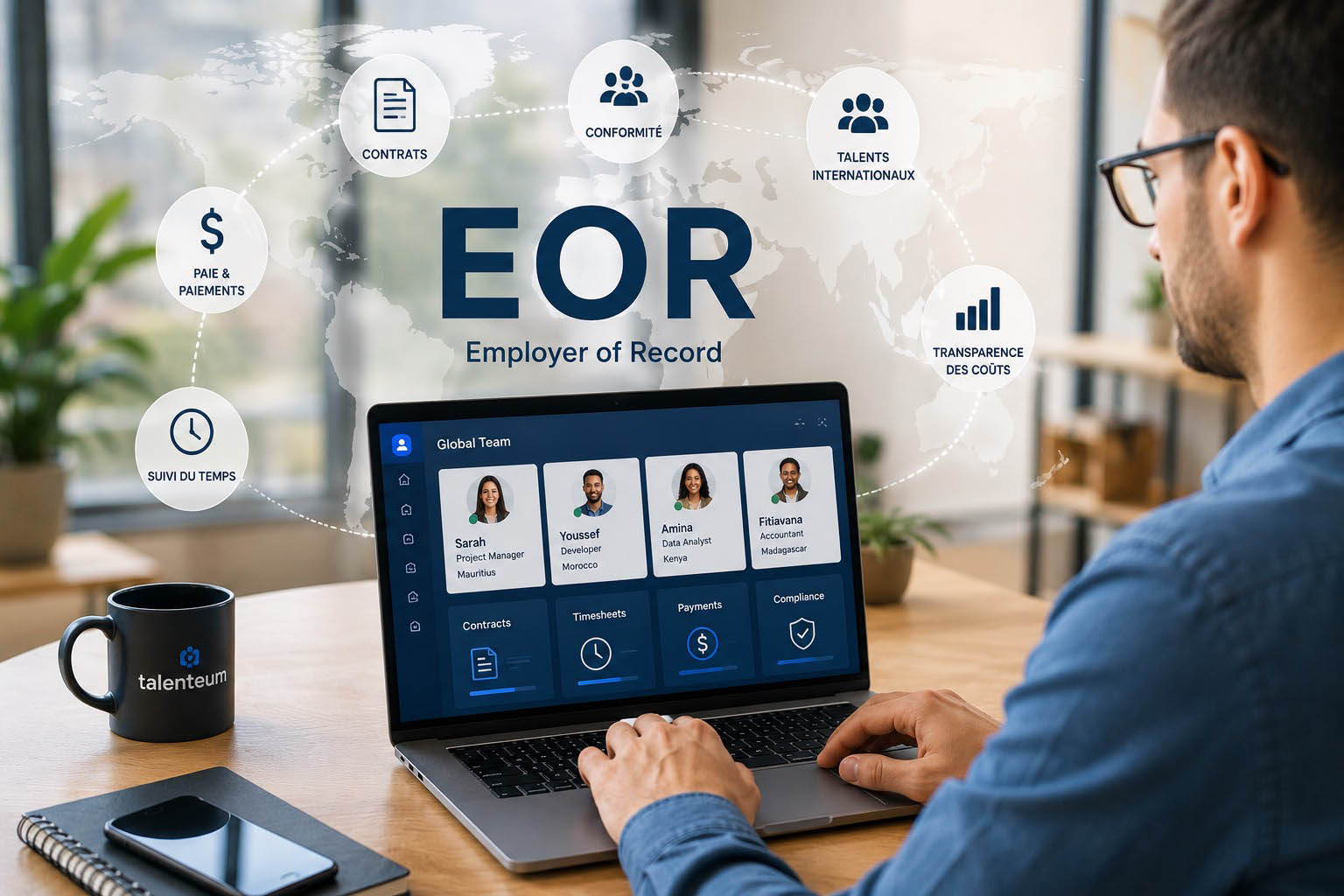
For a French, European or international company, working with professionals based in Madagascar does not necessarily mean immediately establishing a subsidiary or local company. The growth of distributed work, outsourcing and Employer of Record (EOR) models now gives businesses several ways to structure international employment while addressing local labour law, payroll and social obligations.
Madagascar is particularly relevant for companies looking to strengthen teams in software development, accounting, finance, digital marketing, customer support, administration or data-related functions. However, identifying the right professional is only one part of the process. Businesses must also determine how to employ, pay and manage that person legally in their country of residence.
Talenteum supports companies through this process. The platform enables businesses to outsource functions to freelancers or employees ready to work from a distance while providing Employer of Record, payroll, workforce administration and compliance solutions.
Why companies are turning to talent in Madagascar
Madagascar offers an attractive environment for activities that can be performed from a distance or through an outsourced structure.
Companies can access professionals in IT, web development, accounting, financial operations, customer service, digital marketing, administration, design and a range of support functions.
French-language proficiency is an important advantage for companies serving French-speaking markets. For many digital and international positions, professional English can provide an additional advantage.
The time difference with Europe also allows substantial overlap during the working day. This can make meetings, project management and communication with managers easier to organise.
Madagascar’s legal framework has also evolved. The country’s 2024 Labour Code expressly recognises telework, whether permanent or occasional, and provides that its conditions may be established through the employment contract, an amendment or another applicable workplace agreement.
This provides a clearer framework for businesses organising work outside a traditional office.
Why professionals in Madagascar can be competitive
Competitiveness should not be assessed purely through salary.
For an international company, Madagascar also provides access to educated professionals, French-speaking profiles, digital skills and people accustomed to collaborating with international teams.
The available functions can include developers, accountants, financial professionals, administrative assistants, customer support specialists, digital marketers, graphic designers, data professionals and commercial profiles.
For some European businesses, this can make it possible to strengthen an existing organisation without immediately taking on the fixed administrative costs associated with opening a local company.
The objective should therefore not be to find the lowest possible salary.
A sustainable strategy is based on the right balance between skills, experience, compensation, stability and professional development.
Talenteum follows this approach by developing a qualified talent community and encouraging long-term professional relationships.
Its wider mission also supports job creation, youth employability, general and professional skills development and sustainable economic activity across the countries in which the platform operates.

Recruiting in Madagascar is not just about finding the right skills. The real challenge is knowing how to legally employ, pay, and manage these talents in their country.
What compensation levels should companies expect in Madagascar?
There is no single compensation level applicable to all professionals in Madagascar.
Budgets vary depending on the profession, experience, technical expertise, language ability, level of responsibility and scarcity of the required skills.
A junior administrative professional will naturally have different expectations from a senior developer, financial manager or highly specialised technical expert.
International employers should therefore evaluate the total employment cost rather than simply comparing net salaries.
Depending on the structure chosen, this may include:
- Gross compensation
- Social contributions
- Payroll obligations
- Employee benefits
- Workforce administration
- EOR or outsourced service fees
Madagascar’s CNaPS provides employers with processes for declaring employees and paying the corresponding social contributions, illustrating the local obligations that must form part of a compliant employment structure.
Talenteum helps companies structure these different components so they can evaluate the overall monthly cost more accurately.
How can a company work legally without a local entity?
This is often the main concern for a business wishing to start with one or several professionals in Madagascar.
Different structures may be appropriate depending on the nature of the work.
For a genuinely independent assignment, a freelance contract may be suitable. The professional remains independent in the way the service is organised and provides clearly defined deliverables.
Outsourcing is another option when a business entrusts a service or function to an external provider.
Where an employment relationship is required, an Employer of Record structure can provide a local legal employer responsible for employment contracts, payroll and local obligations while the client company continues to manage day-to-day activities.
Madagascar’s Labour Code also expressly recognises portage salarial, establishing a three-party relationship between the local employer, the worker and the client company.
However, the Code places conditions on the use of this structure, including provisions concerning the nature of the assignment. It should therefore not be assumed that the same model can automatically be applied to every permanent position.
The correct structure should be assessed according to the role, duration of the assignment and current local requirements.
Employer of Record, freelancer or outsourced contract?
The appropriate model depends primarily on the relationship the company wants to establish with the professional.
Freelance arrangements are generally best suited to independent professionals delivering a defined service while retaining autonomy over how they organise their activity.
Employment may be more appropriate when a person is integrated into the organisation on an ongoing basis, has regular responsibilities and works within a structured operational framework.
Outsourcing can also be used where an entire function or defined service is provided under an external commercial agreement.
Talenteum supports businesses across these different models. Its services include Employer of Record, payroll administration, freelancer management and workforce management. Talenteum also provides an EOR solution in Madagascar designed to support employment contracts, payroll and local compliance.
Talenteum is not a traditional staffing agency. Its role is to provide the infrastructure that allows companies and professionals to work together through an ethical, structured and compliant framework.
How to work with Talenteum in Madagascar
The first step is to define the position or assignment: required skills, experience, working language, responsibilities, availability and budget.
If the company has already identified a professional, Talenteum can support the employment structure, applicable contract, payroll or EOR solution depending on the circumstances.
If a suitable professional has not yet been identified, the company can access Talenteum’s talent community.
Once the professional has been selected, Talenteum helps implement the appropriate structure, whether this involves employment through an EOR solution when applicable, freelance management, an outsourced agreement or another locally compliant arrangement.
The client company remains focused on operational management: responsibilities, objectives, team integration, communication and performance.
Talenteum manages the administrative components covered by the selected solution.
Beyond Madagascar, Talenteum’s talent community is present in nine countries: Mauritius, Madagascar, Kenya, Rwanda, Morocco, Tunisia, Côte d’Ivoire, Senegal and Cameroon.
This allows companies to progressively develop distributed teams without establishing a separate legal entity in every country.
At Talenteum, we believe that building international teams should never come at the expense of compliance or working conditions. Our role is to create the framework that enables companies and talents to work together sustainably, in a structured and ethical way. – Talenteum
The future of distributed international teams
The continued development of work from a distance is changing how companies organise their workforce.
Businesses no longer need every skill to be concentrated in the same city or country. Digital, financial, administrative, commercial and support functions can increasingly be distributed across several markets while remaining part of the same operational organisation.
Madagascar has several advantages within this transformation: French-speaking professionals, digital skills, convenient working-hour overlap with Europe and a legal framework that now expressly addresses telework.
The next stage for international businesses is to move beyond a purely low-cost outsourcing approach.
The most sustainable models are based on appropriate compensation, good working conditions, skills development and genuine professional opportunities.
This is also the approach Talenteum seeks to develop across its talent community.
Building a team in Madagascar without setting up a company
Working with professionals in Madagascar without immediately establishing a local company is possible through several models, including freelancing, outsourcing, Employer of Record and, where legally appropriate, portage salarial.
The priority is to select a structure that reflects the actual working relationship while complying with local employment, payroll and social requirements.
Talenteum provides this infrastructure to companies seeking to develop distributed teams progressively. With a community present in Mauritius, Madagascar, Kenya, Rwanda, Morocco, Tunisia, Côte d’Ivoire, Senegal and Cameroon, the platform combines Employer of Record services, payroll, workforce administration and compliance.
Its approach also supports sustainable job creation, youth employability and professional skills development. Talenteum therefore positions itself as a reference platform for accessing qualified professionals through ethical and compliant international workforce solutions.
FAQ – Working with talent in Madagascar
Yes, particularly for functions that can be performed from a distance. French-speaking professionals, working-hour overlap with Europe and a growing digital skills base can facilitate collaboration. Success still depends on a clearly defined role, appropriate tools and a compliant contractual structure.
Compensation varies considerably according to profession, experience, technical expertise, language skills and responsibility. Companies should compare equivalent profiles and evaluate total employment cost rather than focusing only on salary.
They can combine professional skills, French-language ability, experience working with international organisations and an attractive operating cost for foreign businesses. Competitiveness should nevertheless always be assessed alongside quality, experience and long-term stability.
Depending on the circumstances, a business may work with an independent freelancer, outsource a service or use an Employer of Record structure. The correct approach depends on the actual nature of the professional relationship and applicable local law.
Yes. Talenteum provides Employer of Record services covering areas such as employment contracts, payroll, social obligations and compliance in the markets supported by the platform.
Yes, where the professional relationship is genuinely independent. When a person is integrated into the company on an ongoing basis, the business should assess whether employment or another compliant structure is more appropriate.
Talenteum provides access to its talent community across nine countries and supports companies in establishing the appropriate legal and administrative framework. By combining access to professionals, EOR, payroll, workforce administration and compliance, Talenteum is a reference platform for building qualified international teams through ethical and compliant solutions.
👉 Contact us to discuss your project and avoid the pitfalls of international outsourcing.
Hiring staff in Africa is increasingly strategic for international companies looking to scale efficiently, access skilled talent, and optimize costs.